OpenAI Launches Codex App for macOS: A Command Center for Agent-Driven Development
The promise of AI in software development has long been framed as a “copilot” experience, an assistant that sits beside you to suggest lines of code or debug errors as you type. However, with the launch of the new Codex app for macOS, OpenAI is signaling a fundamental shift in that dynamic. The role of the human developer is moving from writing code to orchestrating a fleet of autonomous agents.
OpenAI’s new desktop application is designed as a “command center” for managing multiple AI agents simultaneously. While previous iterations of coding tools focused on singular tasks, the Codex app allows users to delegate complex, long-running projects to different agents running in parallel. This release aligns with a broader industry trend where the barrier to entry for building software is lowering, potentially allowing non-technical users to build sophisticated applications by managing AI workflows rather than writing syntax.
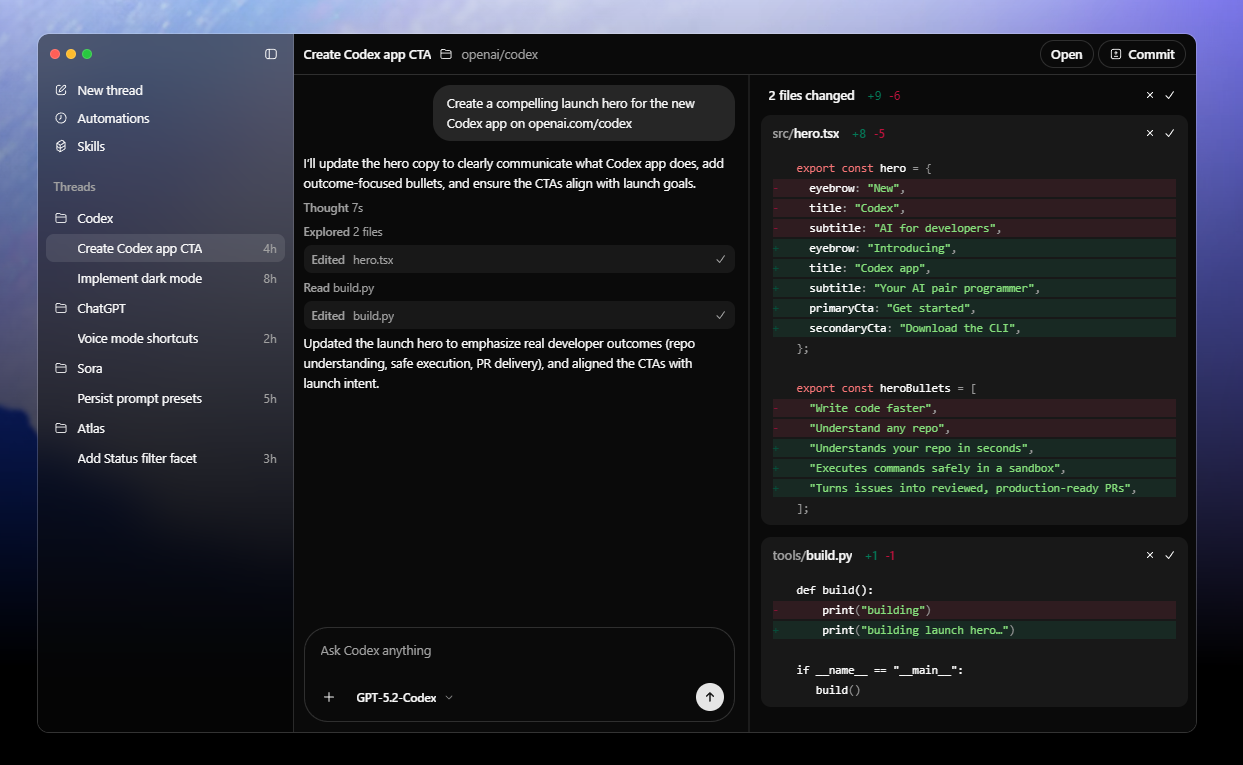
A New Way to Work
The core philosophy behind the Codex app is concurrency. In traditional Integrated Development Environments (IDEs), a developer works linearly on one problem at a time. The Codex app breaks this model by introducing “threads” organized by projects.
For example, a user can instruct one agent to refactor a legacy database schema while simultaneously tasking a second agent with updating the frontend user interface to match new design specs. These agents operate independently, allowing the user to switch context without losing progress.
Technically, OpenAI has solved a major pain point of multi-agent work: version control conflicts. The app utilizes git “worktrees,” meaning each agent works on an isolated copy of the code. This allows agents to experiment or make sweeping changes without disrupting the user’s local environment or interfering with other active agents. Users can then review “diffs” (visual representations of code changes) and merge them when ready.
With the Codex app you can:
— OpenAI (@OpenAI) February 2, 2026
- Multitask effortlessly: Work with multiple agents in parallel and keep agent changes isolated with worktrees
- Create & use skills: package your tools + conventions into reusable capabilities
⁃ Set up automations: delegate repetitive work to… pic.twitter.com/XSVfR281U2
Beyond Syntax: Skills and Skills Bundles
Perhaps the most significant update for general users is the introduction of “Skills.” OpenAI acknowledges that modern software development involves more than just writing logic; it requires interaction with design tools, cloud infrastructure, and project management platforms.
The Codex app launches with a library of pre-built integrations:
- Implement designs: Fetch assets directly from Figma and translate them into production-ready code
- Manage projects: Triage bugs, track releases, and manage workload in Linear
- Deploy to the cloud: Push applications to Vercel, Cloudflare, Netlify, or Render
- Generate images: Create visuals using GPT Image for websites, mockups, and game assets
- Create documents: Read, create, and edit PDFs, spreadsheets, and Word documents
To demonstrate the power of these skills, OpenAI showcased “Voxel Velocity,” a fully functional 3D kart racing game. According to the company, the game, which features eight maps, distinct characters, and drift mechanics, was built by Codex using over 7 million tokens of compute from a single initial prompt. The agent acted as designer, developer, and QA tester, autonomously playing the game to validate features.
Automations and Accessibility
The release also introduces “Automations,” which allow Codex to perform background tasks on a schedule. This feature targets the repetitive maintenance work that often bogs down development teams, such as daily bug triage, analyzing continuous integration (CI) failures, or generating release briefs.
In a move to capture a wider audience, OpenAI is making the Codex app available to ChatGPT Free and Go users for a limited time, alongside its paid tiers. For professional developers on Plus, Pro, and Enterprise plans, the company is doubling rate limits to accommodate the heavy compute load required for running multiple agents in parallel.
The app also addresses the “human” element of AI interaction. Users can now toggle the personality of their agents, choosing between a “terse, pragmatic” style for efficiency or a “conversational, empathetic” style for a more collaborative feel.
Security and Future Implications
As agents gain the ability to execute commands and manipulate files, security becomes paramount. The Codex app operates within a system-level sandbox. By default, agents are restricted to editing files in their specific workspace and using cached web searches. Any action requiring elevated permissions, such as network access or sensitive system commands, requires explicit user approval, though teams can configure these rules for specific projects.
Currently available only on macOS, OpenAI has stated that a Windows version is in development.
The Bottom Line
This release represents a maturing of the “AI coder” concept. By moving the interface out of the traditional code editor and into a dedicated management dashboard, OpenAI is betting that the future of programming looks less like typing and more like management. As the gap between model capability and user accessibility closes, the definition of who counts as a software developer is likely to expand significantly.
With over a million developers already using Codex since GPT-5.2-Codex launched in mid-December, and usage doubling since then, the demand for agent-driven development tools is clear. The Codex app positions OpenAI to capture not just developers, but anyone who wants to build software without learning to code.